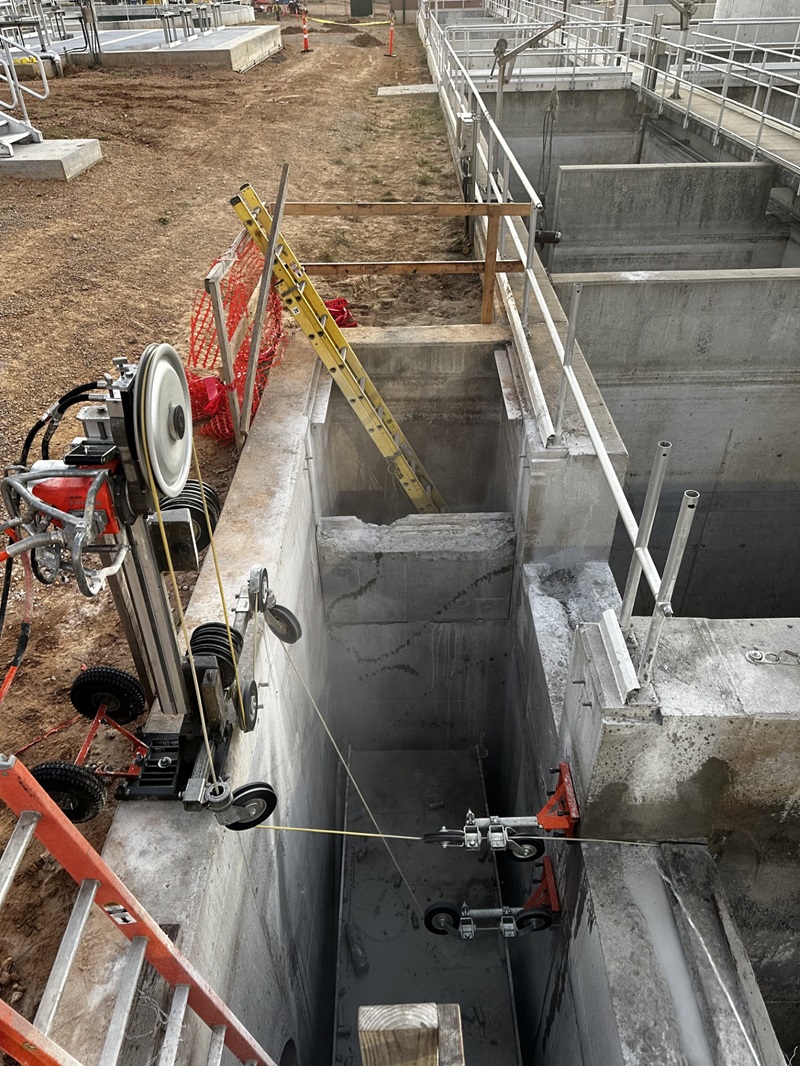
When projects involve cutting or removing large reinforced concrete structures, concrete wire sawing has become one of the most reliable and precise options available. However, traditional cutting tools such as slab saws, wall saws, and chainsaws still play an essential role. Diamond wire sawing has quickly become a leading option for complex or heavy-duty projects, but traditional tools such as slab saws, wall saws, and chainsaws still offer distinct advantages. At Fine Cut Concrete Drilling & Sawing, we use both approaches depending on the material, location, and scope of work. So, how do you know which one is best for your project?
What Is Concrete Wire Sawing?
Wire sawing uses a multi-strand steel wire embedded with industrial diamonds. The wire is looped through or around a structure, tensioned, and run at high speed through a hydraulic or electric system. As the wire moves, the diamonds grind through extremely thick, dense, or reinforced concrete with precision. This method is ideal for:
- Large concrete and steel structures
- Thick walls, columns, piers, and bridge decks
- Industrial equipment and heavy demolition
- Areas with limited access or confined spaces
Because the tool doesn’t rely on blade diameter, there’s no limit to depth or size. That makes concrete wire sawing one of the most versatile cutting methods available today.
What About Traditional Saws?
When using traditional concrete cutting tools, each type serves a specific purpose depending on the surface and access requirements:
- Slab Saws – Ideal for horizontal surfaces such as floors, pavements, foundations, and other concrete flatwork.
- Wall Saws – Designed for vertical surfaces, perfect for precision cuts like window or door openings.
- Chain Saws – Best for tight or confined spaces, cutting corners, small openings, or utility penetrations.
Traditional saws are ideal for jobs that require speed and moderate depth, especially in everyday construction and renovation work. Fine Cut uses these tools daily for utilities, HVAC openings, roadwork, building modifications, and more.
Side-by-Side Comparison
Cutting Depth
- Diamond Wire Sawing: Unlimited, can handle extremely thick structures
- Traditional Cutting: Limited by blade size
Material Strength
- Diamond Wire Sawing: Cuts through heavily reinforced concrete and steel
- Traditional Cutting: Can struggle with very thick or steel-heavy structures
Precision
- Diamond Wire Sawing: Excellent for controlled, accurate removal
- Traditional Cutting: Great for straight, standard cuts
Vibration
- Diamond Wire Sawing: Very low, which helps protect surrounding structures
- Traditional Cutting: Higher risk of vibration damage
Best For
- Diamond Wire Sawing: Bridges, columns, piers, and industrial demolition projects
- Traditional Cutting: Flatwork, walls, standard openings, and utility access
Speed
- Diamond Wire Sawing: Fast on large structures
- Traditional Cutting: Fast on smaller cuts
Fine Cut Delivers the Right Method for the Job
The best concrete cutting solution depends on more than just the tool; it depends on experience, planning, and safety. With Fine Cut Concrete Drilling & Sawing, every project starts with evaluating:
- Material thickness and reinforcement
- Access and space limitations
- Structural concerns and vibration risks
- Environmental and safety requirements
Our trained specialists then select the appropriate saw and approach to ensure safe, clean, and cost-effective results.
Final Thoughts
Both wire sawing and traditional cutting have a place in concrete construction and demolition. The key is knowing when to use each method. With Fine Cut, you don’t have to choose alone; we bring the knowledge, equipment, and precision to get the job done right. Fine Cut Drilling and Sawing serves the greater Kansas City metro area, as well as locations near Bentonville, Arkansas, and Tulsa, Oklahoma. You can contact us today to find out if we service your area.